|
|
Historical Paintings of New England
Exhibited December 15 to May 15, 2010
This exhibit encompasses the work of well known American artists born in the 19th century who painted New England scenes in a wide variety of mediums and styles. These works were chosen to represent the inspiring diversity that is the artistic heritage of the region, including paintings from five members of the National Academy.
Just scroll down to see each painting.
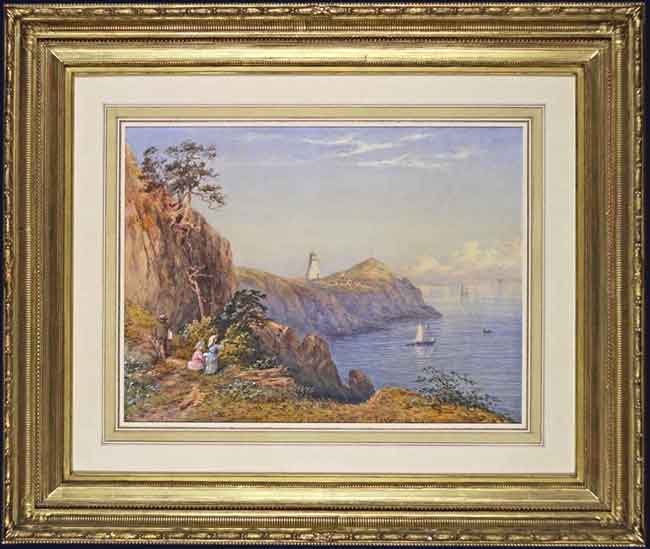
Sparrowhead Light House, Grand Manan
Samuel Peter Rolt Triscott
17.50" x 23.38"
Created: 1890
Framed under glass with mat 28x34
$9000
Samuel Peter Rolt Triscott was born January 4, 1846 in Gosport, England. He was one of five children and had a genteel middle class upbringing. Triscott studied civil engineering. His artistic training in painting was at the Royal Institute of Painters in Water Colors in London under Philip Mitchell.
In 1871 Triscott moved to America and settled in Worcester, Massachusetts where he was a partner in a civil engineering firm. In 1874 he began selling paintings from his office in Worcester. In 1881 Triscott had a one man show at the Boston Art Club. His style of painting with fluent washes of transparent color, though a change from the accepted norm, was well received. Triscott worked as a painting teacher during this time and it is believed his students included Winslow Homer, Sears Gallagher, William J. Bixbee, Woodbridge Gee, Melbourne H. Hardwick, Charles Copeland, William Ladd Taylor, and Robert Henri.
Triscott became quite active in the art world and showed regularly at the Boston Art Club, the American Watercolor Society in New York, The Pennsylvania Academy of Fine Arts and the Gallery of J. Eastman Chase. In 1885, he was one of the founding members of the Boston Society of Water Color Painters.
Triscott began visiting Monhegan Island off the coast of Maine in the early 1890's. The artist purchased a large lot of land which he sold off for cottages in his later years. Every year Triscott increasingly spent more time on the island eventually staying there year round. On April 28, 1894 Triscott was naturalized in Boston. He returned to Monhegan Island and continued to show his work and receive exceptional reviews. S.P. R. Triscott died on April 15, 1925 on Monhegan Island.
Source:
"American Art Review", December 2002
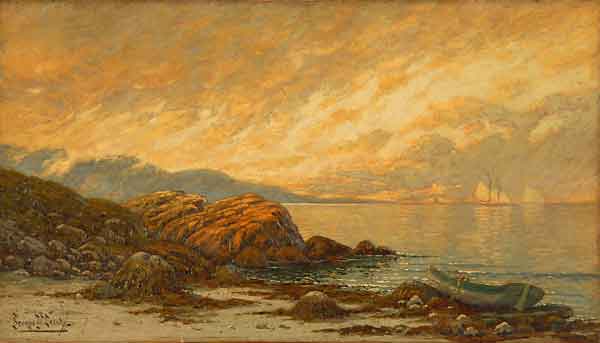
George H. Drew (b. 1833)
Along the Maine Coast, (c. 1880)
12" x 21" Oil/Canvas
SOLD
The son of marine painter Clement Drew, George Drew and his father had a gallery in Boston in the 19th century.

Harrison Bird Brown (1831-1915)
View of Grand Manan
Oil on Canvas 10x18
AVAILABLE
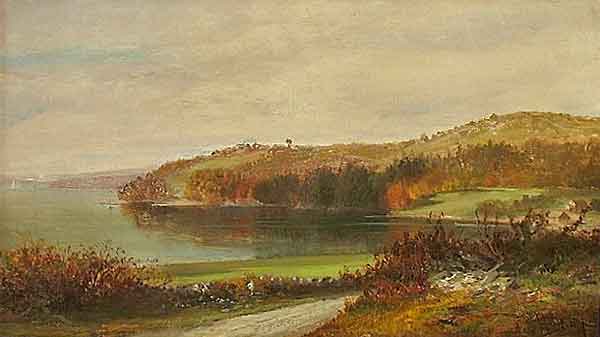
Harrison Bird Brown (1831-1915)
Maine Coast in Autumn
Oil on Canvas 13x23
SOLD
Harrison Bird Brown was born in 1831 in Portland, Maine, and is best known for his White Mountain landscapes and marine paintings of Maine's Casco Bay. By 1860, Brown was being praised as a leading American marine painter.
Landscape painting was popular in the mid 19th century, thanks in part to the influence of Charles Codman (1800-1842), whose paintings were collected for their very romantic sentiments. It is possible that Brown saw examples of Codman's poetic paintings, and was influenced by his works. Brown was one of the early artists to paint the coastline of Maine's Monhegan Island, where he depicted the headlands as awesome, mystical forces. Humanity versus nature, and the human relationship to nature, themes prevalent in mid and late-19th century literature and philosophy, figured frequently in his seascapes.
He often painted in the White Mountains, and his name can be found in the guest registers of many places artists frequented in those mountains. The coast of Maine was also a favorite painting venue of Brown's for over thirty years. He depicted the wholesome outdoor environment of the state, with special fondness for the Casco Bay area and Grand Manan, an island off the New Brunswick, Canada coast. Brown also produced two widely distributed illustrations of Crawford Notch for the Maine Central Railroad in 1890.
Harrison Bird Brown exhibited at the National Academy of Design in New York from 1858 to 1860, and at the Boston Athenaeum and Philadelphia Centennial Exposition in 1876. By 1892 he had become the best known native Maine painter of his time, and gained fame for himself and the state with a large canvas in the Maine pavilion of the 1893 World's Colombian Exposition in Chicago. In 1892 he was elected president of the Portland Society of Art.
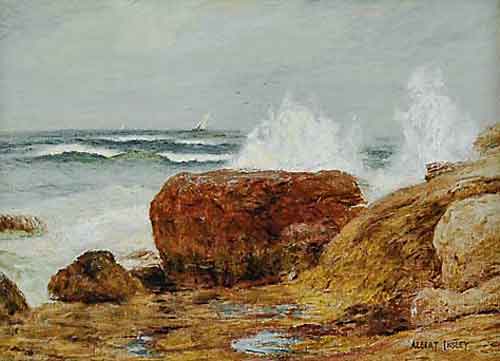
ALBERT BABB INSLEY (1842-1937)
"SURF AT PORT CLYDE, MAINE", 1915.
Oil on canvas 14" x 19" in a fine carved wood gilt frame 22” x 27”
PROVENANCE: Acquired from the grandson of the artist.
SOLD
Landscape and marine painter Albert Babb Insley was born in 1842, growing up in Jersey City, New Jersey. He was active early in the arts. At age fourteen in 1856, he received his first major painting commission of the Llewellyn Park Estate of D.C. Otis; and the same year he left school to become an apprentice photographer under his father, Henry Earle Insley, who was one of the earliest pioneer photographers in America. In 1860, at age 18, Insley made his first of many painting trips to the Green and White Mountains of Vermont and New Hampshire and to the Shawangunk Mountains of New York.
When only twenty-five, Insley began exhibiting on a regular basis at the National Academy of Design in New York City, having exhibited 36 times from 1862 to 1898. He continued his artistic studies, even as an exhibiting artist, with the well-known Jasper Cropsey in 1864 and 1865. By the early 1860s, he was an art instructor with Henry L. Hillyer at New York University, Waverly Place, New York City. He was also a long-time exhibitor from 1869 to 1891 at the Brooklyn Art Association.
In New York City, he lived and worked at the Tenth Street Studio Building for 48 years. He also took regular painting trips north of the city and across the Hudson River in New Jersey, as well as in the New England states. In the early 1880s, Insley's work reflected the influence of the Barbizon School of France. Insley took an art class on glazing techniques with George Inness Sr. who influenced him to become looser and more expressive. During the summers of 1864 and 1865, he studied landscape painting with Jasper Francis Cropsey at his home on Greenwood Lake, which caused him to lighten his palette.
The long-lived artist died in Nyack, New York in 1937 at age 95. His memberships included the Boston Arts Club, Brooklyn Art Association, Nanuet Painters and Sculptors Guild, National Academy of Design, Pennsylvania Academy of the Fine Arts, and the Salmagundi Club. His collections include the Archives of American Art, Washington, D.C.; Cragsmoor Free Library, New York; Delaware Art Museum, Wilmington; Harding Museum, Chicago; Jersey City Museum, New Jersey; Preservation Society, Newport, Rhode Island; and the Rockland Historical Society, New York.
Sources:
Michael David Zellman, "300 Years of American Art"
Peter Falk, "Who Was Who in American Art"
"The Delicate Palette of Albert Insley" Antiques and the Arts Weekly, June 22, 1984
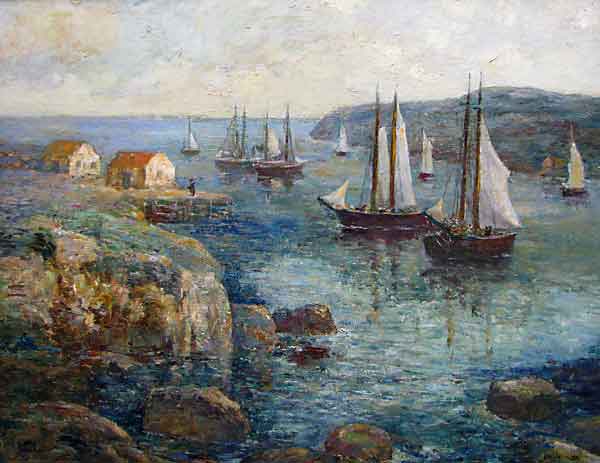
Paul Bernard King, N.A. (1867-1947)
Monhegan Island Harbor
25 x 30 Oil (relined),Antique carved frame 31 x 36
Price available upon request
Versatility, artistic maturity and mastery of technique and medium are hallmarks of Paul King's art. His diverse works of portraits, landscapes, rural scenes and illustrations establish his reputation in the first quarter of the century.
From 1906, when his oil painting "Hauling in the Anchor Line" (date and location unknown) captured the Salmagundi Club's top two prizes, King regularly received recognition. His merit was freely acknowledged by his artist peers, as well as by the critics and the public.
King was born in 1867 to a Buffalo, New York goldsmith. Apprenticed there to a lithography firm, he became an accomplished printer. King later studied at the Art Students League of Buffalo and, from 1901 to 1904, at the New York Art Students League with Henry S. Mowbray. While a student, he was an illustrator for "Life" and "Harper's" magazines. From 1905 to 1906, King studied in Holland with Willy Sluiter, Evert Pieters and Bernard Bloomers.
He was a board member of the Philadelphia School of Design for Women, serving as vice president and acting president, from 1908 to 1921. In 1921, he moved from his long-time home in Germantown section of Philadelphia to Stony Brook, Long Island, where he died in 1947.
Memberships: Allied Artists,America Federation of Arts, Artists Aid Society, Artists Fund Society, International Society of Arts and Letters, Pennsylvania Academy of Fine Arts, Philadelphia Art Club, Salmagundi Club
Public Collections:Albright-Knox Gallery, Buffalo; Butler Art Institute, Youngstown, Ohio; National Gallery of Art, Washington, D.C.; Reading Museum, Pennsylvania; Los Angeles Museum; Houston Art Museum; New Pantheon, Nashville, Tennessee. (From "American Art Analog").
Biography from Roughton Galleries,Inc
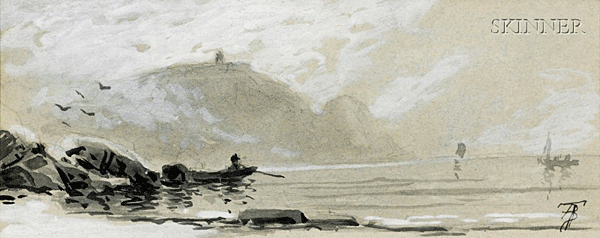
Alfred Thompson Bricher (1837-1908)
Figure in a Boat Near Shore
Monogrammed l.r., labels from Barridoff Galleries, Portland,
Watercolor and gouache en grisaille on paper,
sight size 2 3/8 x 6 in. framed
Born April 10,1837, Portsmouth, NH, Bricher grew up in Newburyport, MA. Largely self-taught by careful study of Cole, Church and Durand, Bricher studied art at Lowell Institute, Boston in the 1850's. In the 1860s he followed his contemporaries to the White Mountains, and was active in Boston and Newburyport, MA until 1868 when he moved to New York.
Bricher was a significant second-generation Hudson River School landscapist and marine painter who is considered to be the last of the relevant American luminists. He is best known for his marine paintings depicting New England shorelines, in which crashing waves show the dynamic forces of nature.With ease and finesse he captured the natural ambiance around the ocean and its coasts and the artist’s reverence for the presence of what is before him is apparent. Keeping in step with the philosophical beliefs of his era, the artist was concerned with equating to canvas the resplendence of nature and the morality of his convictions. He executed his best work during the 1870s-80s when he spent many summers painting on the coasts of Massachusetts, Maine (Monhegan Island), and Rhode Island (1871-76), as well on Long Island, especially at Southampton.
Today A.T. Bricher is considered one of the finest marine painters of his era, and his work is in great demand because each of his canvases and watercolors show resplendently and with confident brushwork how nature looked during the late 19th and early 20th centuries.
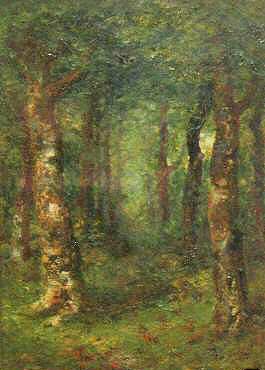
Forest Interior (oil on canvas, 20" x 12")
by Maria a Becket (1840-1904)
Gilded Antique Gold frame, 33" x 29"
price available upon request
Maria A' Becket was a well listed American painter who is cited in many American art references of her era. She was born in 1840 in Portland, Maine, Daughter of Charles Beckett, a Maine Landscape and genre painter. In 1865 she studied with Homer Dodge Martin and later with William Morris Hunt in Boston. She was influenced by the Barbizon painters at Pont Aven and painted with the famous French painter Charles Daubigny during a trip to France.Though her Barbizon influence is often stressed, this work reveals strong elements of Tonalism and Impressionism and is quite similar to her seminal work “Northern Lights”. She exhibited at the Boston Art Club in 1875, the National Gallery in 1883 and 1888, and at the Pennsylvania Academy of Fine Arts from 1880 to 1884 and the New York’s Women’s Club to name just a few. It is only recently that we have fully recognized the great talents of our American women painters and started to give them the praise which they so richly deserve. This new realization has made their works much in demand and valuable.
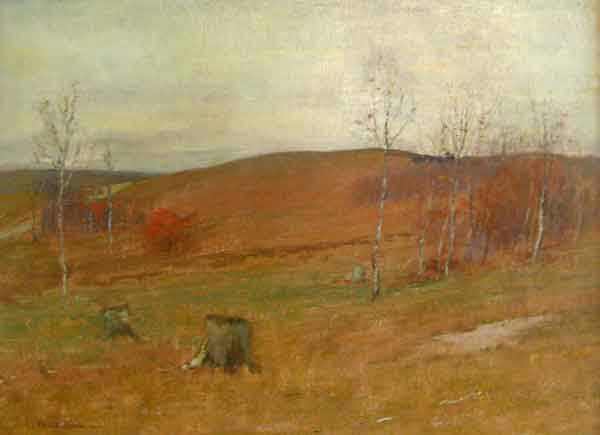
(Robert) Bruce Crane, NA (1857-1937)
FALL CONNECTICUT LANDSCAPE
Signed lower left "Bruce Crane. N.A."
SIZE: 22" x 30"
Fine deep carved frame: 31” x 39”
price available upon request
Robert Bruce Crane was born in New York City on October 17, 1857. The son of Solomon Bruce Crane and Leah Gillespie, he was educated in New York's public schools and was exposed to the city's galleries and museums by his father, himself an amateur painter. By the age of seventeen, Crane had moved to Elizabeth, New Jersey, where he was employed as a draftsman by an architect and builder.
He soon decided to devote his career to painting, and about 1876 or 1877 sought the guidance of the landscape painter Alexander H. Wyant, with whom he subsequently shared a close friendship until Wyant's death in 1892.
Between 1878 and 1882, Crane attended the Art Students League in New York and traveled to Europe for further study. In the United States during this period, he painted in New Jersey; East Hampton, Long Island; and the Adirondacks. He wrote to his father from the Adirondacks that among the influential painters working nearby at the time were Eastman Johnson, George and James Smillie, and Samuel Coleman, and he described the dramatic terrain: "Went to the famous Rainbow Falls which several artists have tried to paint . . . Wyant and Hart among them . . . over the top comes tumbling the water which strikes every few feet throwing a spray which catches the sun giving a most charming as well as wonderful appearance."
Crane spent time in East Hampton, on the eastern end of Long Island, during the summer of 1880 or 1881 and possibly during other summers. From there he wrote his father that the painters "Stimson, Dellenbaugh, Moran, Robbins and Coleman are here . . . I have finished the study of an old house . . . and the artists say that [it] is exceedingly good." In another note he described some of his typical subjects at this time: "I have been working on a 20 x 30 [inch] subject, a row of apple trees, gigantic in size . . . I commence in a few days the study sheep."
In these early works, Crane painstakingly reproduced the pastures, hayfields, and barnyards of rural East Hampton. A critic later remarked that "Troubled or placid skies, the bright luminous atmosphere of a summer's day, or the gray tones of autumn were given in these pictures, not only with truth to nature and a certain poetic sentiment, but with a brilliant sparkling quality of effect.
Source:
Clark, Charles Teaze; "Bruce Crane, Tonalist Painter", Antiques Magazine, November, 1982.
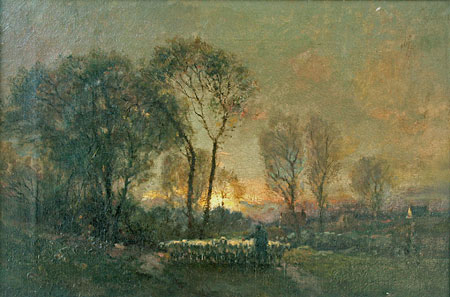
Shepherd's Lane (oil on canvas, 12" x 16")
Charles Appel (1857-1928)
$5000 framed
Born in Brooklyn, New York, Charles Appel is known for romantic landscapes and marine paintings in Tonalist and Impressionistic styles.He was a pupil of Francis Luis Mora and William Merritt Chase at the New York School of Art and of Frank Vincent DuMond at The Art Students League. The major influence on his career, however, was George Inness. Most of his life was spent in East Orange, New Jersey from where he was active in New York art circles and was elected a member of the Salmagundi Club in 1906.
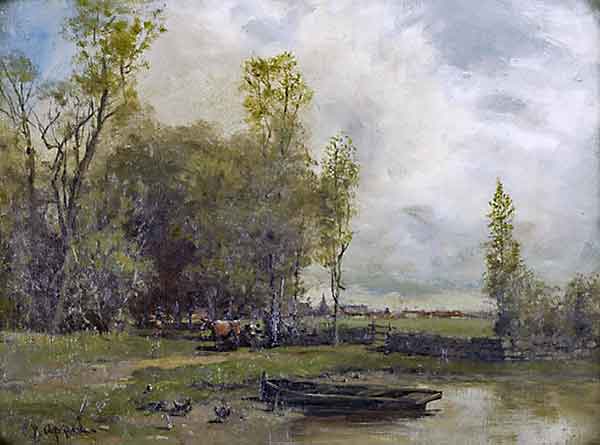
Country Pond
by Charles Appel (1857-1928)
Oil on canvas, 12" x 16"
$3500 in original goldleaf frame
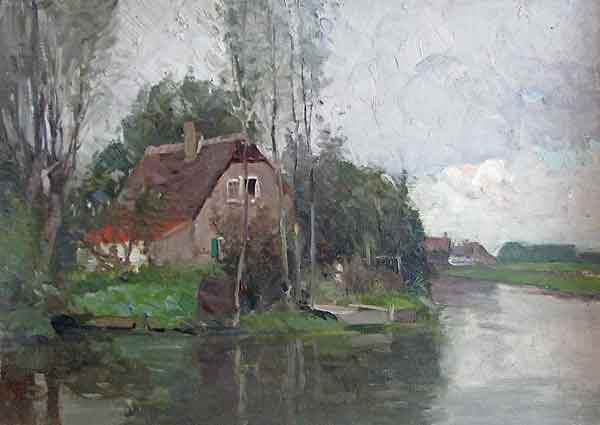
Charles H. Woodbury (1864-1940)
Lakeside Cottage
Oil on Canvas: 10 X 14
$3500
Born in Lynn, Massachusetts, an industrial city about ten miles north of Boston, Charles Woodbury remains among the most influential artists to work in Ogunquit, Maine and in Boston. He taught more than 4,000 students including ones at Wellesley College, had more than 100 solo exhibitions, and wrote three widely read art education books. He remains a strong influence on art education.
Woodbury was from a comfortable, well-established family. He sold his first oil painting when he was 15 and at age 17 in 1884, was the youngest person ever elected to the Boston Art Club. He graduated from the Massachusetts Institute of Technology, and credited Ross Turner, his watercolor instructor, as launching his painting career.
As a young resident painter of Lynn, he was a leader among his artist colleagues in the formal application of paint in beach and marsh scenes, a unique subject for that time. Immediately after graduating from MIT, he set up a studio at 22 School Street in Boston near Charles Green, his close friend and painting colleague. They determined to make a living only from their painting, and they succeeded. His formal art training began in 1890 when he, a newly married man, enrolled in the Academie Julian in Paris and stayed for a year. Returning to the Boston area, he became a prominent plein-air painter and living until 1940 embraced Impressionism.
He was a member of the Salmagundi Club (1899); an Associate (1906) and an Academician (1907) at the National Academy of Design; Ogunquit Art Association; Society of Water Color Painters; New York Water Color Club; Guild of Boston Artists; Boston Society of Watercolor Painters.
He won awards at the Lynn Art Exhibition for Amateurs (1880); Boston Art Club (1884, 1895); Atlanta Exposition (gold, 1895); Nashville, Tennessee Centennial (1897), Mechanics’ Fair, Boston; Paris Exposition (1900); Pan-American Exposition, Buffalo (1901); Worcester Art Museum (1903,1907); St. Louis Exposition (1904); Carnegie Institute (1905); Buenos Aires Exposition (1910); American Water Color Society (1911); W.A. Clark Prize and Corcoran Medal (1914); Pan-Pacific Exposition, San Francisco (gold, 1915); Penn. Academy of F.A. (gold, 1924); Brooklyn (1931); Palmer Marine Prize and Ranger Fund Award, National Academy (1932); Noyes Prize, Society of American Artists (1933).
He is represented at the Gardner Museum; Corcoran Gallery of Art; Art Institute of Chicago; Herron Art Institute; Boston Museum of Fine Arts; St. Louis Art Museum; Boston Public Library; Berkshire Atheneum; Detroit Art Institute; Metropolitan Museum of Art; Joslyn Art Museum; Worcester Art Museum; R.I. School of Design; Telfair Academy, Savannah; Colby College; Wellesley Colllege and in 100’s of other museums and institutions.
Woodbury was given over 60 one-man exhibitions, the first being at the J. Eastman Chase Gallery, Boston (1887) and the last at the Winchester Public Library, MA (1939). 18 Memorial Shows were given (1940-41). In 1945 the Museum of Fine Arts, Boston held a Retrospective Exhibition. In 1968, Adelson Galleries, Inc. (then of Boston) and in 1978 Vose Galleries of Boston gave Retrospectives. In 1988 M.I.T. gave a monumental Woodbury exhibition titled Earth, Sea and Sky that traveled to museums through 1993.
Woodbury taught art at the Worcester Art Association (1895); Wellesley College (1899-1906; 1913-1914); Dartmouth College; Pine Hill School (1907-1910); Ogunquit summer art school (1898-1939); Director, Woodbury School, Boston; Associate Professor, School of the Chicago Art Institute.
Author: The Art of Seeing (1925) and Painting and the Personal Equation (1922).
Sources include:
P.J. Pierce
American Art Review, August 1998
Peter Falk (Editor), Who Was Who in American Art
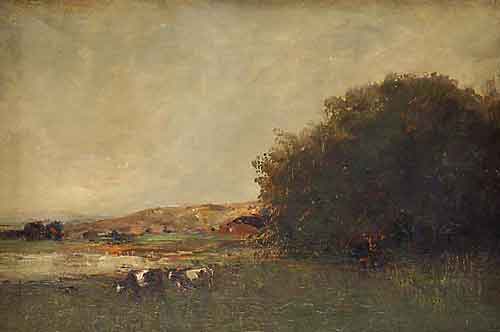
CHARLES EDWIN LEWIS GREEN (1844-1915)
RED ROCK, LYNN, MASSACHUSETTS. 1881
Signed lower right "C Green 81"
Oil on canvas, 11-3/4" x 15-1/2"
$3200
A native of Lynn, Massachusetts, Charles Green became an artist committed to painting American subject matter, especially the marine and landscape scenes of his native area. He often signed his paintings C.E.L. and was part of the seven "Lynn Beach Painters" that included his close friend, Charles Woodbury.
From the 1880s through 1910, he was a regular exhibitor at the Boston Art Club and also took lessons there. He was a plein-air painter, meaning he completed his landscape and marine scenes outdoors with minimal over painting of colors.
In 1885, he moved to Boston, and he and Charles Woodbury had adjoining studios on Green Street and committed themselves to making their living exclusively with their fine art. They succeeded, and for several years, they were linked together as being non-European trained, stay-at-home artists with very similar impressionist styles and American subject matter. They prided themselves on avoiding European influence, but in the 1890s, their styles became increasingly impressionist from seeing European work in Boston exhibitions.
Green had his first one-man show in 1886 at the J Eastman Chase Gallery, one of Boston's most prestigious exhibition venues at that time. In 1906, Green moved from Boston to his hometown of Lynn where in 1909, he became one of the founders of the Lynn Art Club. He died on January 18, 1915, having been a major influence on succeeding generations of painters inspired to paint local marine scenes of the Boston area.
Source: Michael David Zellman, "300 Years of American Art"
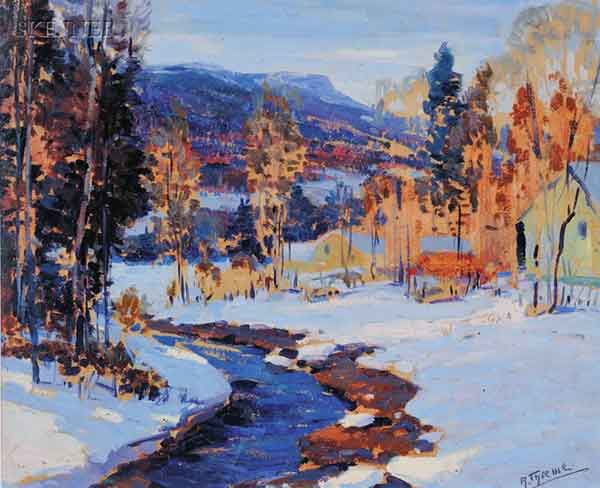
Anthony Thieme, NA (1888-1954)
Landscape in Winter
Oil on Board 13.5x16.5
Framed under glass with mat 21x24
SOLD
Anthony Thieme was born on February 20, 1888 in Rotterdam, Holland. He studied at the Royal Academy of Fine Arts in The Hague, Holland, under George Hacker; Garlobini, Guardaciona; and Mancini in Italy. He also studied in Germany. In the 1920's he emigrated to the United States, initially residing in New York City where he painted Broadway backdrops, and eventually setting up studios in Rockport, Massachusetts and St. Augustine, Florida, seasonally moving from one to the other.
Known as a genre painter he did landscapes including farms, and Paris scenes; his best known works are of boats, fishermen, and harbors, reflecting his Northern and Southern studios in coastal towns. In Rockport, he established the Thieme School of Art where he was Director.
Thieme was a strong proponent of the visual arts and held memberships in many associations: American Water Color Society; Art Alliance of America; Salmagundi Club; Connecticut Academy of Fine Arts; Boston Art Club; Providence Water Color Club; Boston Society of Artists; North Shore Art Association; Springfield Art League; Rockport Art Association; New York Water Color Club; American Artists Professional League; Gloucester Society of Artists; Art Alliance of Philadelphia; Philadelphia Painters Club; and the National Arts Club.
As a function of these many memberships, he was an active exhibitor: National Academy of Design 1930-1934; Art Institute of Chicago 1930; Pennsylvania Academy of Fine Arts 1929-1931; Corcoran Gallery of Art 1932; Los Angeles Museum of Art 1930, 1931 (prize); Albright Art Gallery 1932; Detroit Institute of Art 1931; Salmagundi Club 1929 and 1931 (prizes); Springfield, Utah 1928 and 1931 (prizes); Gloucester Art Association 1928 (prize); Springfield Art League 1927 and 1928 (prizes); North Shore Art Association 1930 (prize); Connecticut Academy of Fine Arts 1930 (prize); Jordon Marsh Exhibition (Boston) 1944 (medal); New York Water Color Club 1930 (prize); Boston Tercentenary Exhibition 1930; Ogunquit Art Center 1930; New Haven Painters and Clay Club 1931 (prize); Washington Water Color Club 1931(prize); Los Angeles Museum of Art; Buck Hill Falls Art Association (Pennsylvania) 1938 (prize); he also exhibited in Belgium, France and Holland.
Anthony Thieme's work is held in high regard by collectors and Museums alike, and he is represented in many major collections: Boston Museum of Fine Art; Pittsfield Museum of Art (Massachusetts); Albany Institute of History and Art; Dayton Art Institute; City of New Haven Collection; College of Springfield (Utah); University of Iowa; Museum of Modern Art; Los Angeles Museum of History, Science & Art; Beach College, Storrs, Connecticut; Montclair Art Museum (New Jersey).
In literature, he is internationally recognized appearing in Benezit; Davenport; Fielding; Mallett; Thieme-Becker; the Witt Library Computer Index; and many "Who's Who."
The Rockport Art Association held a retrospective exhibition of his works and the accompanying text details his life and works: Judith A Curtis, "Anthony Thieme 1888-1954," Rockport Art Association, 1999. (80 pages)
Source: Edwin J. Andres Fine Art
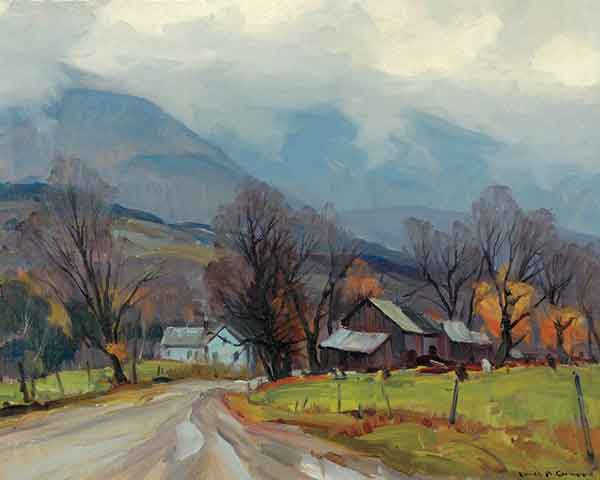
Emile Albert Gruppe (1896-1978)
Rainy Day, Vermont
Oil on canvas, 24 x 30 in
Price available upon request
Born in 1896 the son of renowned tonalist painter Charles Paul Gruppe, Emile Gruppe became one of the 20th century’s masters of New England seascapes and landscapes. In addition to being raised by an artistic father, he was also educated in art at The Hague in the Netherlands and in New York City at the National Academy of Design and The Arts Students League. He also received instruction from artists George Bridgeman, Charles Chapman, Richard Miller and John F. Carlson. Throughout his career Gruppé exhibited at the major national annuals, including those of the National Academy of Design, where he made his debut in 1915. His paintings were also shown at the Connecticut Academy of Fine Arts, the North Shore Art Association, the Rockport Art Association, where they won numerous awards and prizes. In 1942, he founded the Gruppe Summer School in Gloucester with his mentors.
Gruppe painted numerous works throughout his long artistic career, as many as 200 hundred oils a year. He is best known for his impressionistic landscapes of Vermont, painted figures and portraits, and especially for his Gloucester and Rockport harbor and village scenes. For the majority of his professional career, he worked and lived in Gloucester, Massachusetts, often wintering in Vermont and Florida.
During this time, Gruppé adopted a more direct and personal mode of painting in which he combined a dynamic brand of Realism with the light and atmospheric concerns of Impressionism. This later work is sought after for its distinctive, vigorous brushwork, compositional qualities and refined color values. Gruppe lived a long and prolific life, passionate about his art and about sharing the joys and skills of visual creativity with future generations. In one of his last interviews he revealed his philosophy of painting: "If you want exacting details in a painting, than you might as well look at a photograph. I make an impression on a canvas, and let one's imagination fill in the details." He died in 1978 at the age of 82 after a lifetime of painting.
Gruppe's works can be found in the Richmond Art Museum, the Hickory Museum of Art, Springville Museum of Art, Whistler House Museum of Art, and more. His works are now highly collectible and have brought dramatic prices near $60,000 at auction.
Source: AskArt.com
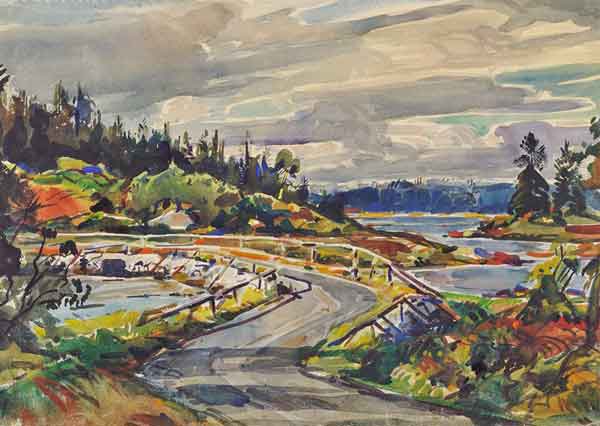
William Lester Stevens, NA (1888-1969)
Deer Isle, Maine
Signed "W. LESTER STEVENS N.A." l.r.
Watercolor 20 x 27 in.
Matted and Framed, Condition: excellent
$2400
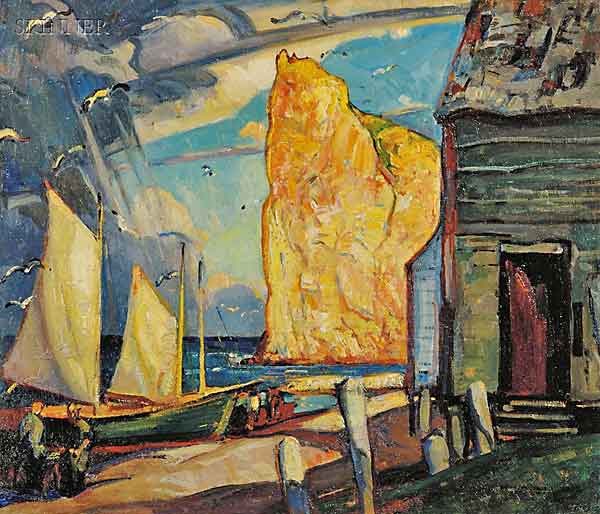
William Lester Stevens (American, 1888-1969)
Gaspe Peninsula, Perce Rock
Oil on Canvas, 24 x 28 in.
$7500
Born in Rockport, Massachusetts, Stevens spent four years at Boston's Museum of Fine Arts School, where he studied under Edmund Tarbell, among others. Primarily an oil painter, he also used watercolor and acrylics. He is best known for his post-impressionistic landscapes. Throughout the course of his long career, Stevens taught, first in Rockport, then at Boston University (1925-1926) and Princeton (1927-1929), and during the Depression at Grand Manan. He was a National Academician and a member of the American Watercolor Society; a founding member of the Rockport Art Association; Springfield, MA Art League; Guild of Boston Artists; Gallery on Moors; New Haven Paint and Clay Club, CT; Gloucester Society of Art; North Shore Art Association; Boston Watercolor Club and the New York Watercolor Club. He won art awards at the Corcoran Gallery, Washington, DC; American Watercolor Society; New Haven Paint and Clay Club; Springfield Art League; Salons of America; Washington Watercolor Club; North Shore AA; Rockport AA and more.
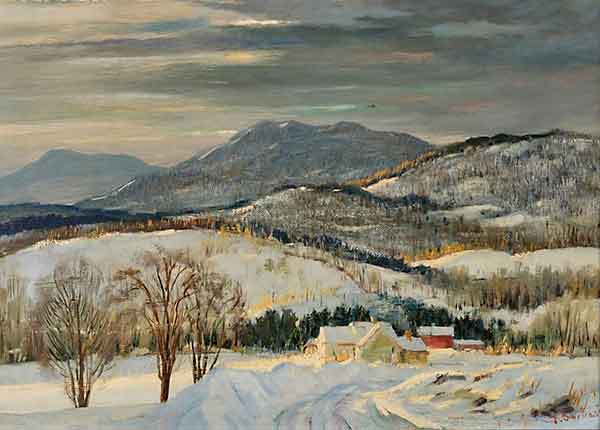
Frank Gervasi, NA (1895-1986)
Winter Morning, Vermont
Oil on Canvas 12x16
SOLD
Gervasi was born in Palermo, Sicily, and immigrated to New York at the age of 13 in 1908. His art career was interrupted by World War I, in which he lost his right arm at the Battle of Somme in France. He overcame this adversity and inspired other wounded veterans when he learned to paint with his left arm. He studied at the Art Students League in New York with important artists such as Robert Henri and George Luks, and was elected a member of the National Academy of Design (hence the initials N.A. after his signature) in 1956. In 1960 he relocated to Marfa, Texas, to complete a mural commission. He remained in Marfa, painting landscapes in Texas and New Mexico, until his death at the age of 91. His paintings are in museum collections in Minnesota, Colorado, and Texas, and he is listed as a a well-sold artist in auction directories including ArtPrice and AskArt.
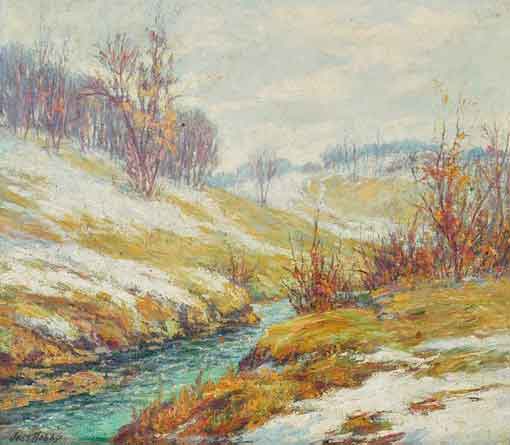
Jess Hobby 1871-1938
Spring Thaw
Oil on Board 16 x 20
$2500 Framed
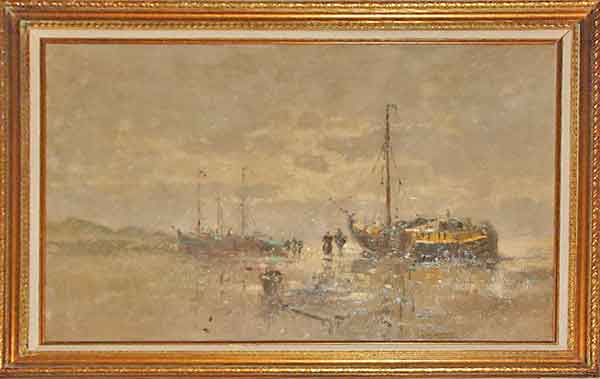
William Norton (1843-1916)
Disemarking at Low Tide
Oil on Canvas 24 x 36
$5500 framed
Born in Boston in 1843, William Norton became a noted marine painter, stirred by his youth when he sailed on family-owned ships. He studied at the Lowell Institute in Boston, and with George Inness, and then established a studio in Boston.
In the early 1870s, he went to Paris and became a student with Chevreuse and A. Vollon, and then he settled in London where he exhibited throughout the last quarter of the 19th century. His reputation there was based on his scenes of the Thames River, and ocean and coastal views.
In 1901, he and his wife returned to the United States and settled in New York City. He also painted at Monhegan Island, Maine, where a treacherous ledge on the southern side of the island is named "Norton's Ledge" for him.
He was a member of the Boston Art Club with whom he exhibited from 1873 to 1909. He also exhibited with the Pennsylvania Academy, the Royal Academy in London, the Paris Salon, the 1893 Chicago Exposition, and the Art Institute of Chicago.
Source: Who Was Who in American Art by Peter Falk
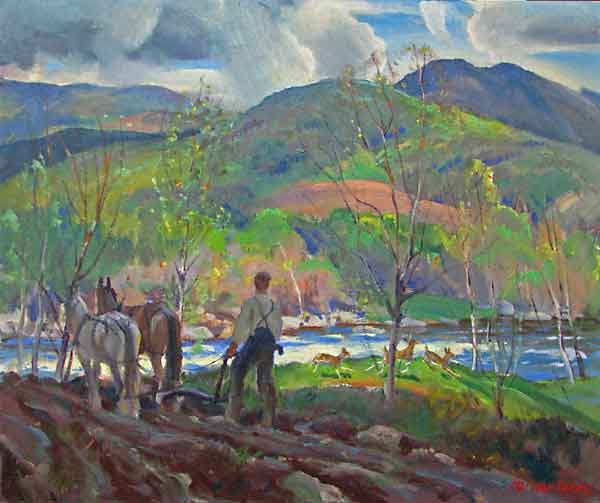
MacIvor Reddie (American, 1864-1931)
Ploughing the Fields (c.1900)
30 x 36 oil on canvas
Framed in Gold 34 x 40
$3800
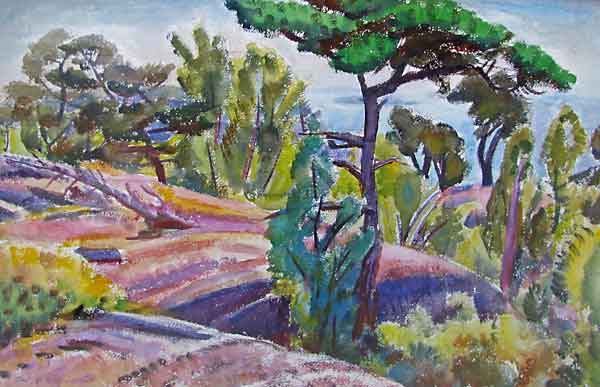
Carl Gordon Cutler (1873-1945)
“Umbrella Pine”
Watercolor on paper, 19.5x 24.5”
Framed 30 x 37
$2400
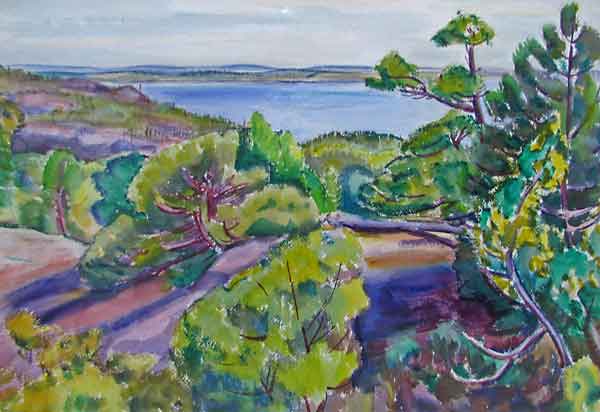
Carl Gordon Cutler (1873-1945)
“View of Eggemoggin Reach”
Watercolor on paper, 17.5x 24.5”
Framed 30 x 37
$2400
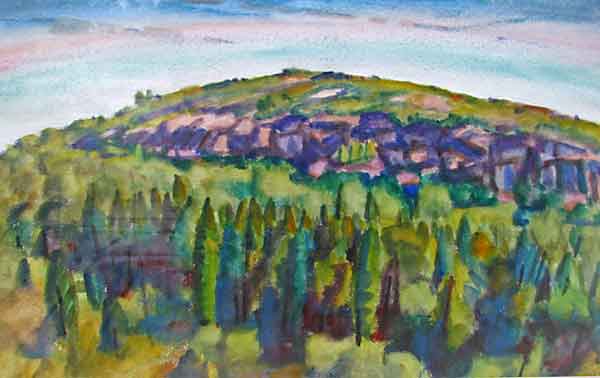
Carl Gordon Cutler (1873-1945)
“After the Rain”
Watercolor on paper, 17.5x 24.5”
$2400 Framed (30 x 37)
Carl Gordon Cutler was born in 1873 in Massachusetts. Though educated in the painting of portraits in oil, his two major artistic passions would become the landscape of Maine and the use of watercolor. His watercolors, influenced by Fauve color and John Marin's forms, were exhibited in Europe and the eastern United States, in Boston; Philadelphia; the Museum of Modern Art, and Whitney Museum of American Art, both in New York City; and, farther west, at the Art Institute of Chicago, Illinois; as well as Paris, France. Cutler had more than a dozen one-man shows in New York City and Boston.
Cutler studied in the late 1890s at the School of the Museum of Fine Arts, Boston, where influence of the old masters on the painting of oil portraits was strong. He also worked at the Academie Julian in Paris. Cutler had some exhibition success there, but it would take several years after his return to America before his mature style would appear. Cutler first painted the Maine coast soon after the Armory Show. By the mid-1920s, he was painting watercolors of the state's landscape exclusivelyviews of Deer Isle, Mount Desert, the Camden Hills and--for thirty summers, Eggemoggin Reach, where Cutler had a cottage. The artist received the plaudits of the critics and acclaim from the public. He spent the last 30 years of his career focusing entirely on painting Maine's Penobscot Bay region.
Carl Cutler was a respected color theorist. In his 1923 book Modern Color, with Stephen C. Pepper, he explained a detailed system involving a scale of 168 colors, telling how to imitate the appearance of natural light through their use. He also discussed emotion as a significant element in artistic creation. In 1994, the Vose Gallery, in Boston, put out a color brochure, Carl Gordon Cutler Along the Maine Coast 1873-1945. Also in the 1990s, the Babcock Gallery, in New York City, published Carl Gordon Cutler, American Modernist Rediscovered, a paperback with forty-four color reproductions and an essay. In 1998, the Portland Museum of Art, in Maine, held an exhibition, "Modern Color": Maine Watercolors by Carl Gordon Cutler, comprised of sixteen out of a total of fifty-nine Cutler watercolors bequeathed a year earlier to the Museum by Mr. and Mrs. James E. Haas. Also in 1998, the College of the Atlantic, Bar Harbor, Maine, exhibited fourteen of Cutler's Maine coastal landscapes painted in the South Brooksville area on the Blue Hill Peninsula.
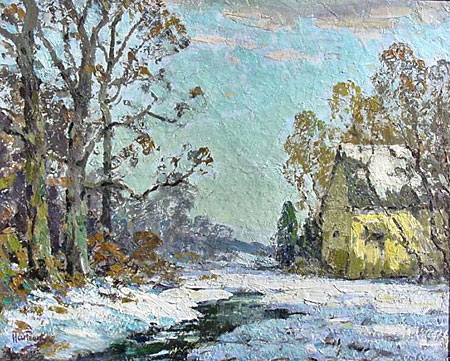
Walter C Hartson (American, 1866-1946)
Landscape with Houses (oil on canvas, 16x20)
In a frame measuring 22 x 26
Walter C Hartson, 1866-1946, was born in Iowa, studied at the Art Institute of Chicago, then in New York City, Holland and England. On his return from Europe he painted mainly in New York and New England including the Old Lyme and Litchfield Connecticut areas, exhibiting widely from the 1895 Atlanta Expo to Pennsylvania Academy, Chicago, National Academy of Design, Boston Art Club, Corcoran Gallery and more, and he won several prizes. He lived in New York City early in the 20th century, settling upstate in Wassaic New York around 1917. In the 1930s he was honored in his mature years to be included in the New York State WPA Art Project, with its emphasis on artistic renderings of historic buildings to record them in their settings for posterity -- thus his late impressionist oils of old stone houses along rivers in New York's Columbia and Dutchess Counties.
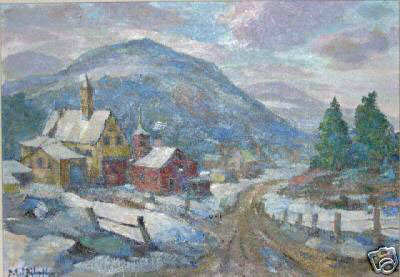
Peter Bela Mayer (1887-1993)
Vermont Winter
10" x 14" oil on board Condition: Excellent
Peter Bela Mayer is primarily known for his impressionist works of the New England landscape and locations near his home on Long Island at Port Washington. He was born in Hungary and added the name Peter in the 1940s to avoid confusion with female painters. From 1908 to 1915, he studied at the National Academy of Design. He first earned public attention in 1914 when one of his pieces was shown at the Corcoran Gallery in Washington DC. During the 1920s, he exhibited at the Pennsylvania Academy of the fine Arts, the Art Institute of Chicago, and the Brooklyn Museum.
Source: 300 Years of American Art, by Michael David Zellman
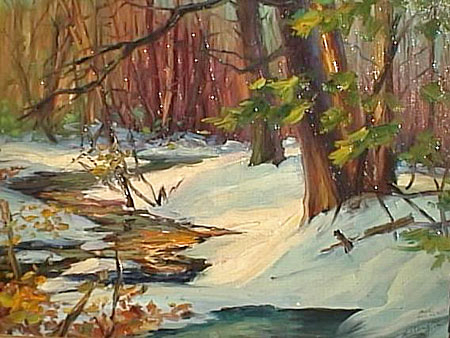
Paul Wesley Arndt, 1881-1978.
Winter Stream, (oil on canvas, 21" x 27")
frame from Belgium 26.5" X 32.25".
Paul Wesley Arndt was trained by in Paris by Jean Leon-Gerome at the Ecole des Beaux Arts and the Art Institute of Chicago. This oil on canvas depicts a snow covered stream outside Woodstock and is signed and dated 1929 lower right.
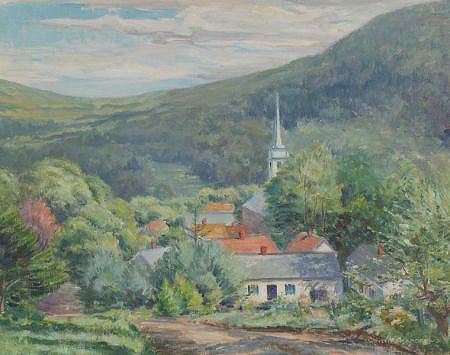
Grafton Vermont
J. Winthrop Andrews (American, b. 1879)
Oil on canvas, 24 x 30 in.
in a Newcomb-Macklin frame.
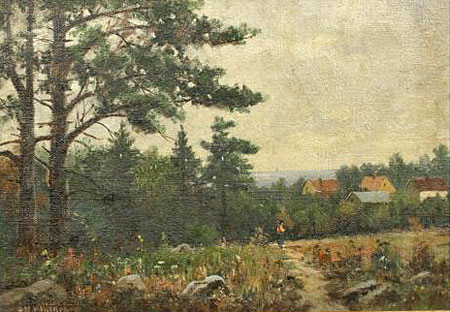
William Henry Hilliard (American, 1836-1905)
Landscape with Houses (oil on canvas, 11 3/4" x 16 1/2")
In a frame measuring 15 1/2" x 20 1/4".
William Henry Hilliard, born in Auburn, New York, in 1836, was a painter of realistic, tonal landscapes related to the Hudson River School. He studied in New York City prior to painting in England and Scotland, then studying with Lambinet in Paris, France. Until 1878, he was based in New York City, but moved to Boston, Massachusetts. Though he did paint in the West before traveling to Europe to study, he later became known for his New England landscapes, views of Maine, the Atlantic Coast, White Mountains and Franconia Mountains. He exhibited at the National Academy of Design, New York City, from 1876 to 1888, and the Brooklyn Art Association, in New York, as well as many other national venues, winning prizes and medals.
Milton, Blue Hills
John Joseph Enneking (1841-1916)
Signed and dated "Enneking 93" l.l.,
catalog raissonee label from Pierce Galleries
14 x20 in Antique Frame 19 x 26
Known for Barbizon and Impressionist styles, Enneking was one of the most popular landscape painters of New England and one of its most successful financially. Enneking held membership at the Boston Art Club, Connecticut Academy of Fine Arts and the Salmagundi Club. His works are part of the collections of the Boston Museum of Art and the Worcester Art Museum, Farnsworth Art Museum,etc.
In 1868 he went to Boston, where he studied lithography and began to paint landscapes. The catalyst for his success came while studying in France with Leon Bonnat and Charles Francois Daubigny during the 1870s on an extended stay, and when he is said to have painted with Monet. Enneking returned to Boston in 1876, and in 1878, his first solo in Boston sealed his reputation. Beginning in the early 1880s he spent summers in North Newry, ME. He also painted frequently in the White Mountains, favoring its trout brooks and woodland scenes.
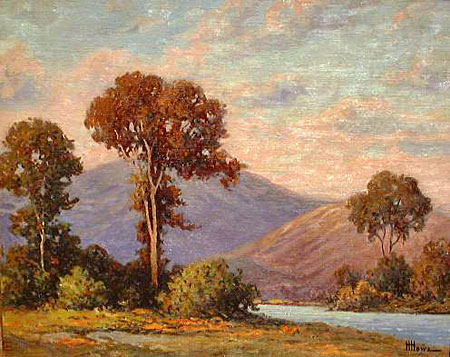
Harry Hambro Howe (1886-1968)
Landscape with Houses (oil on canvas, 16 x 20)
In a frame measuring 20 x 24
SOLD
Fine oil on artist board painting of a New England river scene by listed American artist, Harry Hambro Howe (1886-1968). Harry H. Howe was the son of T. Bailey Howe who is well known (T. Bailey) as an early 20th century New England painter known for his paintings of clipper ships and harbor scenes. His son, Harry H. Howe lived in Maine and he also painted New England scenes, clipper ships and Nantucket scenes. This oil painting is in very good condition and there are some vibrant colors and nice evening light with lots of shades of pink and blue in the sky.
|
The BLUE HILL BAY GALLERY, located on Main St in Blue Hill village, is open daily in the summer from 10-4, otherwise by chance or appointment.
See the calendar for future exhibitions.
|

|
|